def is_old_property(built_year, current_year=2024):
if (current_year - built_year) > 10:
return "aged10"
else:
return "new"
is_old_property(2010)'aged10'如果程序需要根据一定条件执行不同的操作,就需要使用条件语句
if condition1:
    expression1
else
    expression0
if condition1:
expression1
elif condition2:
expression2
elif condition2:
expression2
else
expression0if condition1:
expression1
if condition2:
expression2
else condition3:
expression3
else
expression0condition 条件表达式的结果必须是 bool 类型elif 可以有任意多个,也可以是 0 个if-else 结构可以嵌套根据二手房的建成年份判断是不是 10 年以上的老房子。 如果是,标记为
"aged10";如果不是,标记为"new"。
def is_old_property(built_year, current_year=2024):
    if (current_year - built_year) > 10:
        return "aged10"
    else:
        return "new"

is_old_property(2010)'aged10'根据二手房的建成年份进行房龄分级。 如果是 20 年以上,标记为
"aged20"; 如果是 10 年以上,标记为"aged10"; 如果 10 年以下,标记为"new"。
. . .
def proeprty_age_label(built_year, current_year=2024):
    if (current_year - built_year) > 20:
        return "aged20"
    elif (current_year - built_year) > 10:
        return "aged10"
    else:
        return "new"

print(proeprty_age_label(2000))
print(proeprty_age_label(2010))
print(proeprty_age_label(2020))
aged20
aged10
new上次我们定义了一个函数,根据二手房总数和每页显示的数量计算总页数。
def page_num(page_size, total):
    return total // page_size + int(total % page_size > 0)
但是有一个隐藏条件:
page_size的值不能是 0,而且一般也不能超过 20。 修改这个函数,当条件不满足时,返回 0 。
and or 等。def page_num(page_size, total):
if page_size > 0 and page_size <= 20:
return total // page_size + int(total % page_size > 0)
else:
return 0
print(page_num(0, 100))
print(page_num(1000, 845))
print(page_num(20, 845))0
0
43这里事实上使用 0 作为一种错误代码。 一般情况下,page_num 为 0 ,表示没有页,属于一种错误情况。 这种情况下,我们就可以停止爬虫。
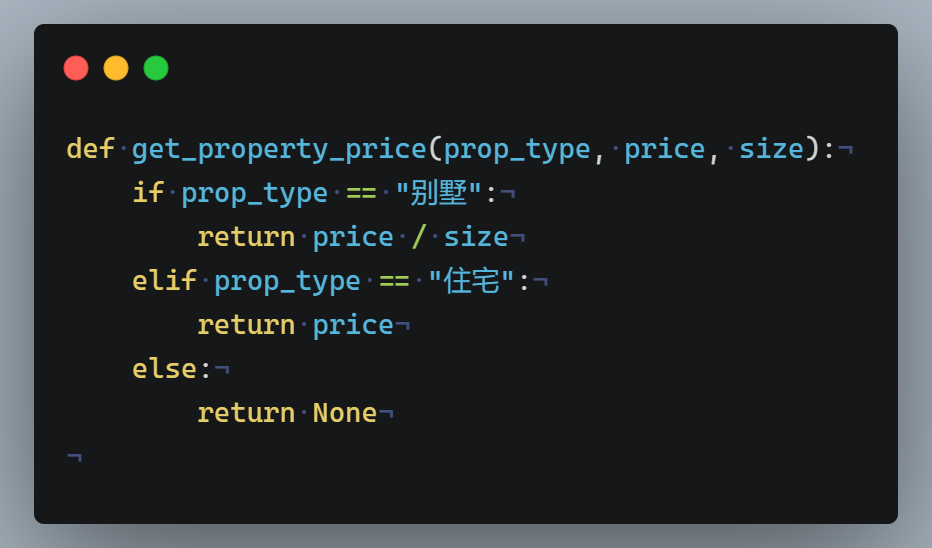
Python 中通过缩进区分不同层级的代码。
: 后就表示开始一个新的层级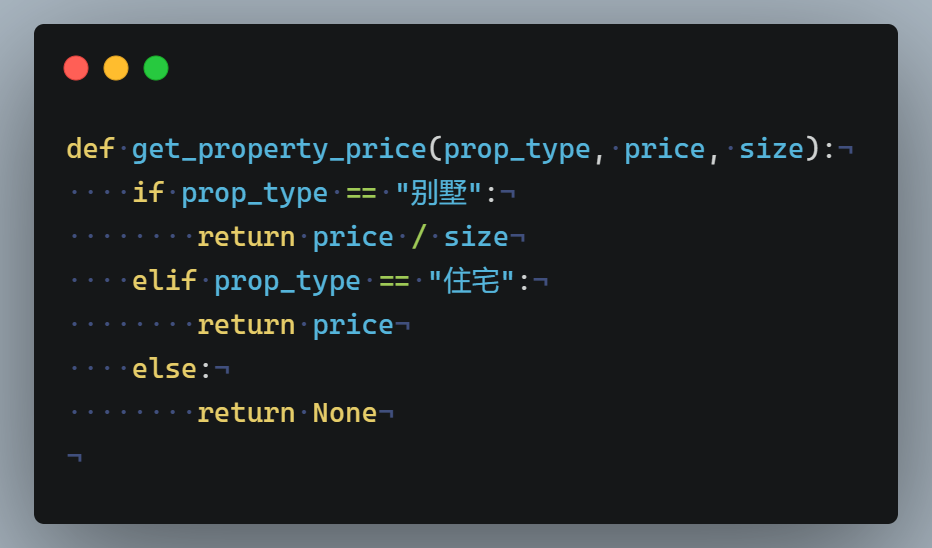
当 if 语句中的条件由很多部分组成时,Python 一般从左到右逐个判断。 但是当某一个语句的结果判断完成后,如果后面的判断无法改变这个结果,Python 就不再继续判断了。
or 连接,其中一个是 True 时,触发短路,结果是 Trueand 连接,其中一个是 False 时,触发短路,结果是 False这个特性可以保证可读性和正确性。
通常情况下,如果一个变量的值可以是
None,那么我们称这个变量是可空变量。 但是对于字符串,不一定只有值是None的字符串才是空字符串。 值是""的字符串实际上也是空字符串。 写一个函数,判断一个字符串实际上是不是“空”字符串。
def is_null_str(value):
    if (value is None) or (len(value) == 0):
        return True
    else:
        return False

print(is_null_str(None))
print(is_null_str(""))
print(is_null_str("abc"))
True
True
False同样的问题,但是写一个函数判断是不是非空字符串。
def not_null_str(value):
    if (value is not None) and (len(value) > 0):
        return True
    else:
        return False

print(not_null_str(None))
print(not_null_str(""))
print(not_null_str("abc"))
False
False
True如果要对一组变量执行同样的操作,可以使用循环语句。 循环语句有两种,for 循环和 while 循环。
For 循环又称“迭代”,是最常用的一种循环。
for item in iterable:
# 对 item 执行一些操作item 是循环变量,依次从 iterable 中取一个值。iterable 位置上的一定是可以迭代的。
list dict set tuple 都是可以迭代的。range 的返回值也是可以迭代的enumerate zip 的返回值也是可以迭代的现在有一批房子的建成年份,根据这些年份进行分级。
prop_years = [1998, 2005, 2007, 2012, 2016, 2019]for item in prop_years:
print(proeprty_age_label(item))aged20
aged10
aged10
aged10
new
new写一个函数,输出一个整数除了1和它本身以外的所有因数。
def fractions(value):
    for i in range(2, value):
        if value % i == 0:
            print(i)

fractions(24)
2
3
4
6
8
12fractions(15)3
5当循环范围无法确定,只能确定循环执行的条件,使用 while 循环。
while (condition):
operationscondition 是 True 时,执行 operations 的操作;operations 的操作,检查 condition 是否还满足;
condition 仍然满足,再次执行 operations 的操作,然后再检查;condition 不满足了,就不再执行 operations 的操作。计算一个正整数的阶乘。
def factorial(x):
    result = 1
    while x > 0:
        result = x * result
        x = x - 1
    return result

factorial(5)120计算几何级数 \(y = \sum_{i=0}^\infty \frac{1}{2^i}\) 的数值,精度为 \(1 \times 10^{-6}\)。 也就是说,当计算结果的变化不超过 \(1 \times 10^{-6}\) 时,停止计算。
def geometric_progression(base=2, eps=1e-6):
    result0 = 0
    result = 1
    power = 0
    while (result - result0) > eps:
        result0 = result
        power = power + 1
        result = result + 1.0 / (base ** power)
    return result

geometric_progression()1.9999990463256836循环里面也可以写循环,但是要注意循环变量不要重复。 这种循环被称为多重循环。
for i in range(0, 10):
    for j in range(0, 10):
        print((i, j))
多重循环有的时候不得不用,但是尽量减少使用。
给定一个最大值,查找不大于该最大值的自然数中的质数。
def prime_number(upper):
    if upper <= 1:
        return []
    elif upper == 2:
        return [2]
    primes = []
    for i in range(2, upper + 1):
        has_factor = False
        for j in range(2, i):
            if i % j == 0:
                has_factor = True
        if not has_factor:
            primes = primes + [i]
return primesprime_number(20)[2, 3, 5, 7, 11, 13, 17, 19]prime_number(50)[2, 3, 5, 7, 11, 13, 17, 19, 23, 29, 31, 37, 41, 43, 47]当输入值越来越大时,得到结果的过程也会越来越慢。
在循环中,使用 break continue 两个关键词可以主动控制循环的走向。
break 使循环立刻终止,不再执行循环体内后面的语句,直接回到循环体外。continue 跳过这一次循环中后面的语句,直接进入下一次循环。通常和判断语句一起使用。
计算之前那个几何级数, 但是要求迭代次数不超过 10 次,如果超过了,就直接返回当前的结果。
def geometric_progression2(base=2, eps=1e-6, max_iter=10):
    result0 = 0
    result = 1
    power = 0
    it = 0
    while (result - result0) > eps:
        result0 = result
        power = power + 1
        result = result + 1.0 / (base ** power)
        if it >= 10:
            break
    return result

geometric_progression2()1.9999990463256836房地产交易平台上,通常只有别墅的房价是以总价的形式显示的,其他都是按单位面积均价显示。 编写一个函数,将所有价格统一处理成单位面积均价的形式。 房地产信息由字典给出。
def process_price(property_list):
    for item in property_list:
        if item['type'] != '别墅':
            continue
item['price'] = item['price'] / item['size']continue 并不是总是非常必要,通过调整判断条件大多数情况下都可以避免。continue,可以减少嵌套层级。与循环语句类似,由一个叫“列表推导式”的语法,可以从一个列表得到另一个列表。 也可以设置一些条件。
[opeartion(x) for x in iterable]
[opeartion(x) for x in iterable if condition]
上面的例子可以直接使用列表推导式
[proeprty_age_label(item) for item in prop_years]['aged20', 'aged10', 'aged10', 'aged10', 'new', 'new']列表推导式非常重要!
现在有一组坐标,精确到小数点后 6 位,按照之前的方法转换成唯一标识。
coords = [(112.2452, 20.45456), (112.456127, 20.145678), (112.976825, 30.142501)][f"{round(c[0], 6)}-{round(c[1], 6)}" for c in coords]['112.2452-20.45456', '112.456127-20.145678', '112.976825-30.142501']我们也可以将循环变量直接展开为两个元素,这种语法被称为“解包”。
[f"{round(lon, 6)}-{round(lat, 6)}" for lon, lat in coords]['112.2452-20.45456', '112.456127-20.145678', '112.976825-30.142501']给两个向量(默认为列向量),计算内积 \(\mathbf{x}^\mathrm{T} \mathbf{y}\)。 如果 \(\mathbf{x}=(x_1,x_2,\cdots,x_n)\), \(\mathbf{y}=(y_1,y_2,\cdots,y_n)\), 那么 \(\mathbf{x}^\mathrm{T} \mathbf{y} = \sum_{i=1}^n x_i y_i\)。
x = [1,2,3]
y = [4,5,6]zip 可以将两个列表并列。sum([xi * yi for xi, yi in zip(x, y)])32莱布尼兹级数 \(1 - \frac{1}{3} + \frac{1}{5} - \frac{1}{7} + \frac{1}{9} + \cdots = \frac{\pi}{4}\) 。 只计算前 100 项的和并乘以 4。
(1 + sum([((-1) ** i) / (2 * i + 1) for i in range(1, 100)])) * 43.131592903558553假设一个向量有 \(n\) 个元素,计算从第一个元素开始到每个元素位置的累积和。 比如,\([1,2,3]\) 的累积和是 \([1,3,6]\)。
_ 表示不需要的元素。enumerate 可以获取元素的序号。def accumulate(vec):
return [sum(vec[0:(i+1)]) for i, _ in enumerate(vec)]
accumulate([1,2,3])[1, 3, 6]类似于列表推导式,字典推导式如下
{key_operation(x): value_operation(x) for x in iterable}
{key_operation(x): value_operation(x) for x in iterable if condition}
需要注意的是:
key_operation 还是 value_operation 都可以和 x 无关key_operation(x) 的结果必须是一种“可哈希”的类型,包括 int float str bool tuple 以及其他所有具有自定义哈希方法的类型。哈希的具体原理暂时不用深究,记住这几个类型即可。
现在有一组元组构成的列表,元组有三个元素,分别表示小区名、小区均价和物业费。 为了便于读取,将元组列表转换成字典,以小区名为键,值是字典
{'avg_price': price, 'management': fee}
communities = [('A', 1.2, 1.2), ('b', 2.3, 1.3)]{x[0]: {'avg_price': x[1], 'management': x[2]} for x in communities}{'A': {'avg_price': 1.2, 'management': 1.2},
'b': {'avg_price': 2.3, 'management': 1.3}}将字符串列表转换为字典,键是字符串,值是长度。
tokens = [
    'abcdefg',
    '1927h3ksmfd',
    '19lpwwodksj'
]
{i: len(i) for i in tokens}
{'abcdefg': 7, '1927h3ksmfd': 11, '19lpwwodksj': 11}实际中,我们会对数据进行分组,然后计算这个组的某个指标,比如数量、平均数等。
{opeartion(x) for x in iterable}
{opeartion(x) for x in iterable if condition}
重复元素会自动被去除。
(opeartion(x) for x in iterable)
(opeartion(x) for x in iterable if condition)
元组推导式的结果并不是一个元组,而是一个类似于 range 的生成器,并不会立刻求值。
自定义类